Your oven was set to 450°F for two hours and the inside was barely warm enough to touch – nobody wants to deal with that, especially when dinner is on the line. This guide walks you through the most common reasons an oven stops heating properly and what you can check yourself before picking up the phone. Coquitlam homes run the full range of appliance ages and types. Older ranchers in areas like Burke Mountain often have appliances that have been running hard for a decade or more, while newer builds in Westwood Plateau tend to have more recent equipment – but that doesn’t make them immune to heating problems. At Appliance Repair Coquitlam, we get calls about ovens not reaching temperature more than almost any other issue, and the good news is that a fair number of these problems have straightforward explanations you can investigate yourself. The tricky part is knowing where to start. A gas oven and an electric oven fail in completely different ways, and even within those categories, the symptoms can overlap. An oven that’s lukewarm when it should be roaring hot could be a failed heating element, a knocked-out temperature sensor, a tripped breaker, or something as simple as a door seal that’s letting heat escape. Let’s work through it.
Key takeaways
- A heating element that looks blistered, bubbled, or cracked has almost certainly failed and needs to be replaced before the oven will heat properly.
- A healthy bake element should read somewhere between 10 and 75 ohms of resistance on a multimeter – zero resistance means it’s done.
- Most ovens take at least 12 to 15 minutes to preheat; if yours is taking significantly longer than that, something is off with the heating system or airflow.
- The temperature sensor should sit at a 90-degree angle to the back wall – if it’s been knocked out of position, it can cause wildly inaccurate temperature readings without any parts actually being broken.
- A tripped circuit breaker is often the first thing to check and the easiest to fix – it takes about 30 seconds and costs nothing.
- If your gas oven smells like rotten eggs beyond the first few seconds after ignition, stop what you’re doing, leave the house, and call your gas company.
Why your oven isn’t heating – the short answer
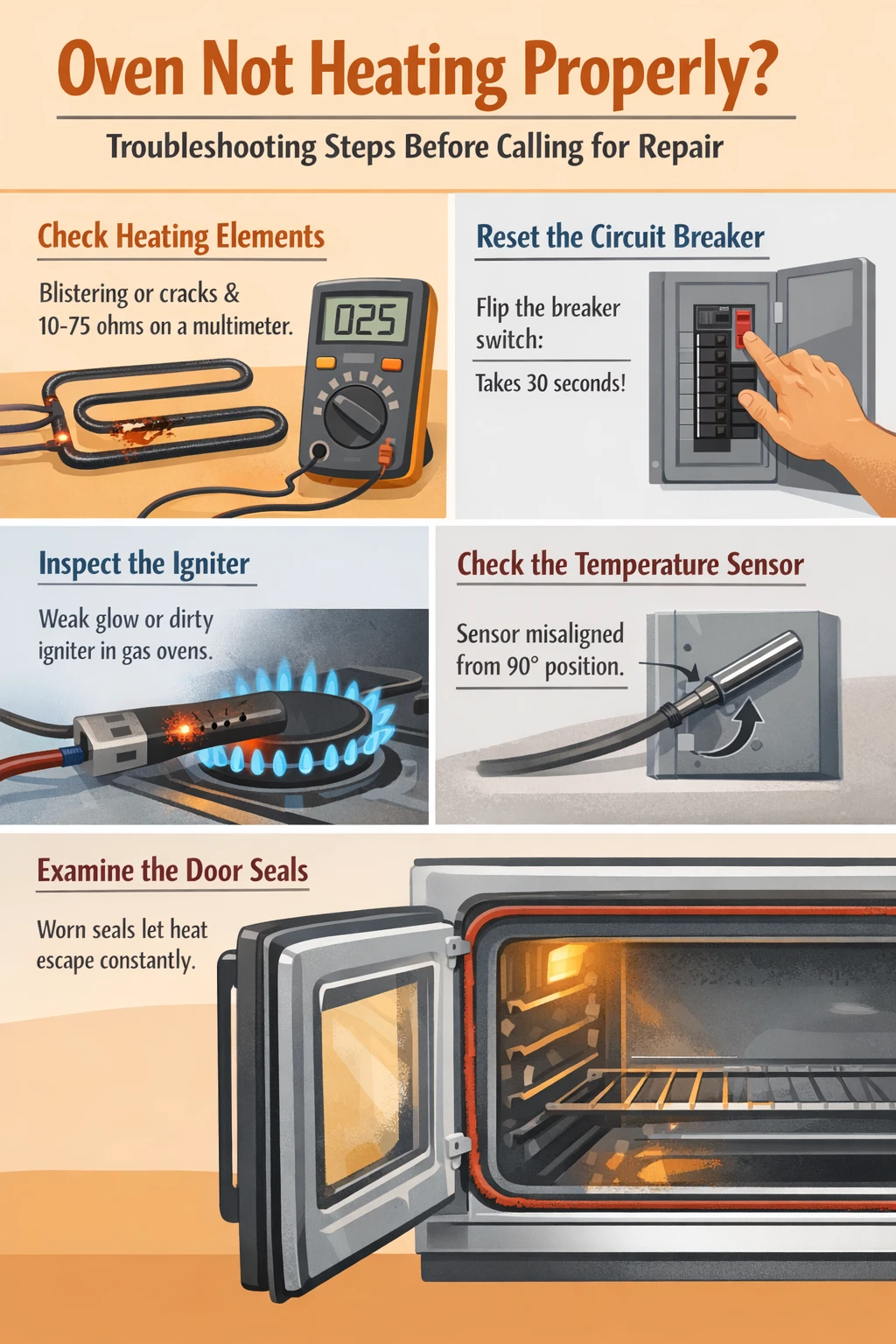
An oven that won’t heat properly is almost always caused by one of a handful of things: a failed heating element (electric), a faulty igniter (gas), a damaged or displaced temperature sensor, a tripped circuit breaker, or a door that isn’t sealing correctly. Start with the simplest checks first. Breaker, door seal, visible element damage. If those are all fine, you’re digging a little deeper. We see this pattern regularly – homeowners assume the worst when the fix turns out to be a tripped breaker or a bake element that gave a pretty obvious visual warning. On electric ovens, a working bake element glows bright orange-red when the oven is heating. If it’s dark, that’s your clue. Gas igniters should glow bright orange and you should hear a clicking sound followed by the whoosh of ignition. Silence is a bad sign. The one thing worth saying upfront: working on anything electrical or involving gas lines isn’t a casual weekend project. Diagnosing the problem is often safe enough. Replacing wiring, testing live terminals, or touching the gas line is a different matter entirely.
Start here – the easy checks
Before assuming a part has failed, go through the basics. It sounds almost too simple, but a surprising number of oven problems trace back to things that take two minutes to check. First, look at your circuit breaker panel. Electric ovens run on 240 volts and use a double-pole breaker. If one leg of that circuit has tripped, the oven might turn on and show signs of life but only heat weakly – because it’s running on half its normal power. A fully tripped breaker will have the switch sitting in the middle position, not hard to one side. Flip it fully off, then back on. If it trips again immediately, there’s an electrical problem that needs a licensed electrician. Check the oven door while you’re at it. Run your hand along the rubber gasket that seals the door to the oven frame. It should feel soft and make good contact all the way around. A cracked, torn, or hardened seal leaks heat constantly, and the oven will struggle to reach temperature no matter how well everything else works. Also make sure your oven racks are pushed in fully and nothing oversized is blocking the door from closing completely. One more thing – check the control panel for a lock setting. Some oven models have a “Control Lock” or “Demo Mode” that limits what the oven will do. Holding the control lock button for three seconds usually resets it. Check your owner’s manual if you’re not sure where it is.
Electric oven not heating – checking the elements
Electric ovens typically have two elements: the bake element at the bottom and the broil element at the top. For normal baking, it’s the bake element doing most of the work. When it fails, the oven either stays cold or barely warms up. Turn the oven on to 350°F and watch through the window for a few minutes. The bake element should begin glowing orange-red within a couple of minutes. If it stays dark while the oven is calling for heat, the element has likely failed. Take a close look at the element itself – if you see bubbling, blistering, cracks, or spots where the outer coating has ruptured, that’s a definitive failure. A physical break in the element means it cannot conduct electricity, and no amount of troubleshooting will fix that short of replacement. 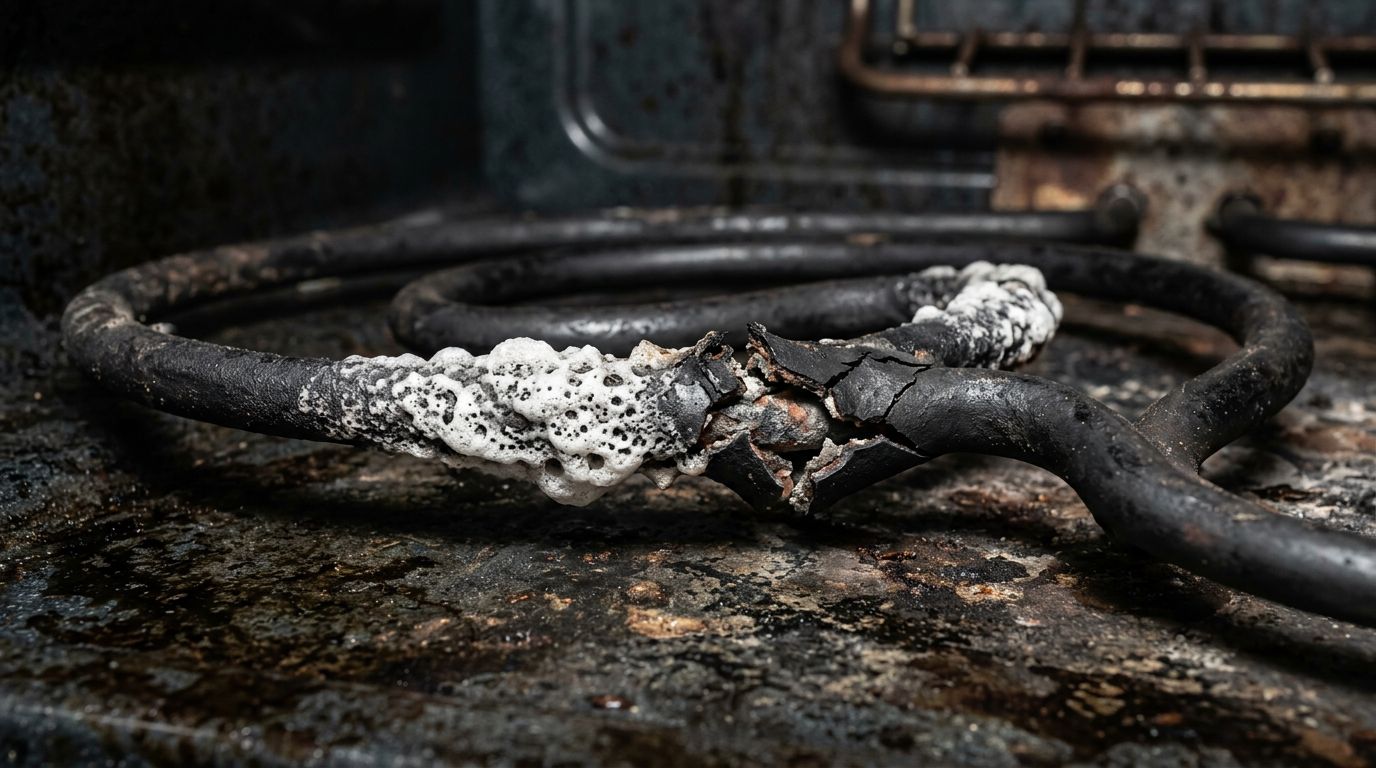 If you have a multimeter, you can test the element properly. With the oven unplugged (not just turned off – actually unplugged or with the breaker off), remove the element and test for resistance across the terminals. A good element should show somewhere between 10 and 75 ohms. Zero resistance means the element is open-circuited and has failed. If you’re not comfortable with a multimeter, the visual check for obvious damage is usually enough to confirm things.
Replacing a bake element
Replacement is straightforward if you’re comfortable with basic appliance work. The element is usually held by two screws at the back of the oven cavity and connects via spade terminals on the wires. The important thing: when you pull the element forward to disconnect it, do not let the wires retract back into the wall. They can slip through the hole into the insulation, and fishing them back out turns a 20-minute job into a much longer one. Hold onto them while you work. Replacement elements are typically not expensive and are available through appliance parts suppliers using your model number. That said, if you’re uncertain about any step, this is a good job to hand off to a technician. The repair itself is inexpensive even with a service call.
Gas oven not getting hot – igniter and gas supply
A gas oven that won’t heat up properly most often has an igniter problem. The igniter does two things: it glows to provide ignition, and it also draws enough current to open the gas valve. If the igniter is weak or failing, it may glow but not get hot enough to open the valve fully – meaning less gas gets through, a weak flame results, and the oven struggles to reach temperature. When you turn on a gas oven, you should hear a series of clicks followed by the sound of gas igniting – a soft whoosh. Watch through the oven window if you can. A healthy igniter glows bright orange. A failing one may glow only faintly, or may take much longer than usual to ignite the gas. If you’re seeing a long delay before ignition, or the oven makes repeated clicking sounds without lighting, the igniter is the likely culprit. 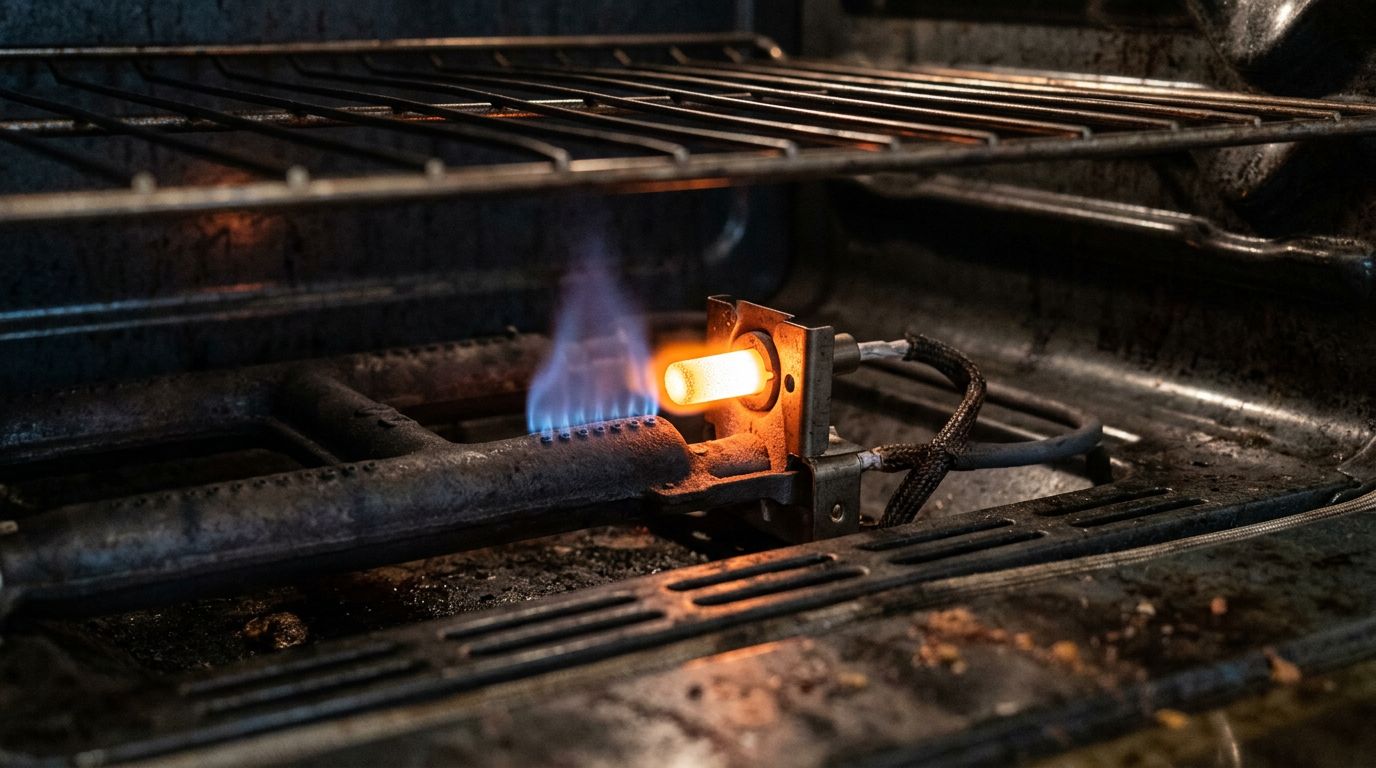 Dirty igniters can sometimes be cleaned following the instructions in your appliance care guide. If there’s no visible debris and it’s still not performing, replacement is the answer. This is a job for a licensed technician in most cases, since it involves the gas supply system. One separate thing to check: make sure the main gas valve is in the open position. It sounds basic, but after any work on a gas line or appliance installation, it’s easy for a valve to end up partially closed.
Temperature sensor and calibration issues
This is the one that confuses people most, because the oven turns on, the element heats up, everything seems to be working – and yet the food comes out half-cooked. The temperature sensor is usually to blame. The sensor is a thin tube, typically located in the back corner of the oven cavity. It monitors the internal temperature and tells the control board when to cycle the heating elements on and off. If the sensor has been bumped out of its correct position – it should sit at a 90-degree angle to the back wall – it can read the temperature incorrectly and cut power to the elements long before the oven actually reaches the set temperature. The fix might be as simple as gently repositioning it. 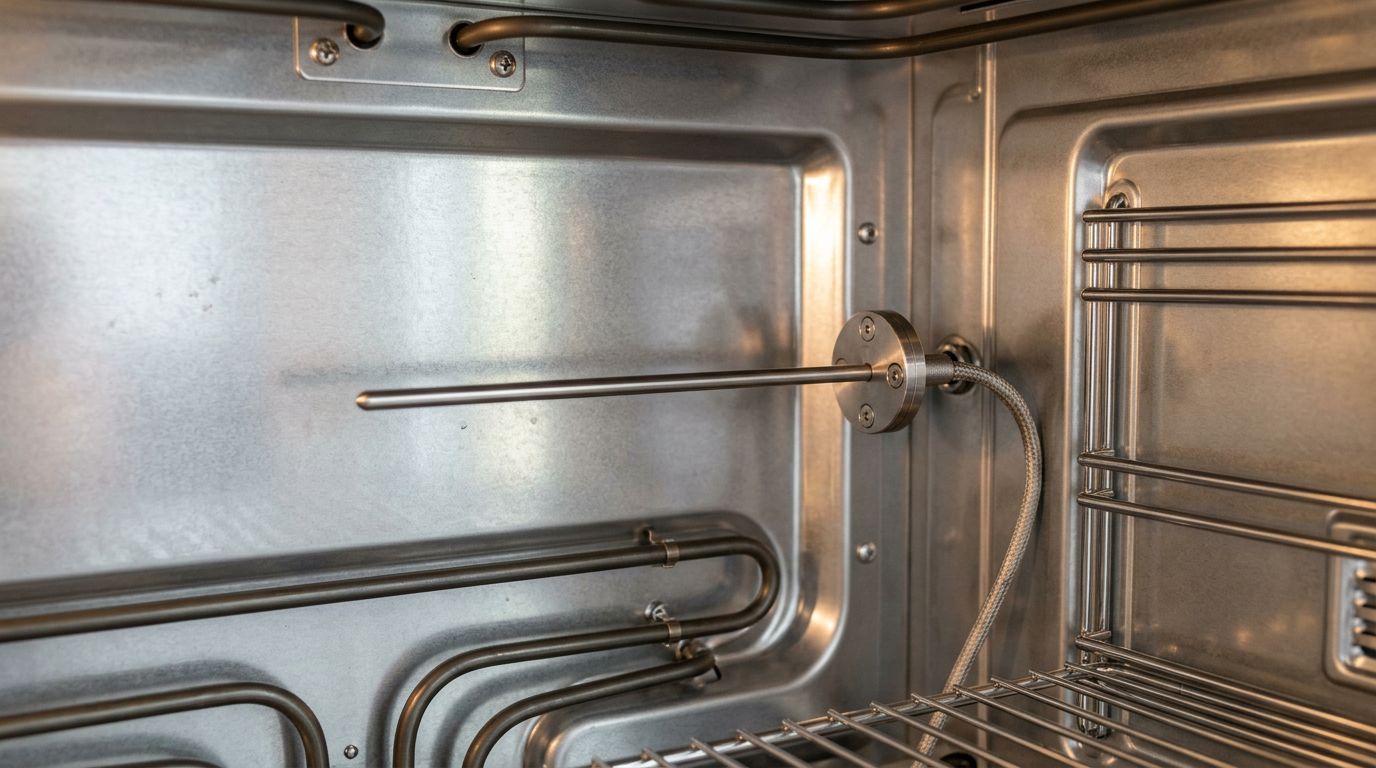 If the sensor is in the right place and still seems off, an oven thermometer is your best diagnostic tool. Hang a separate oven thermometer inside, set the oven to 350°F, and let it stabilize for 20 minutes. If the thermometer reads 290°F when the oven thinks it’s at 350°F, you have a calibration or sensor problem. Many ovens allow for manual calibration – for electronic controls, the common method is pressing BAKE and BROIL together for two seconds until the display shows “SF,” then adjusting up or down by pressing BAKE followed by the plus or minus keys. The range is typically up to 35°F in either direction. Check your owner’s manual for model-specific steps, since the process varies. A damaged sensor needs to be replaced. It’s usually not an expensive part, but consulting your owner’s manual before attempting any repair is always the right first move.
When the oven door isn’t holding heat
A compromised door seal is one of those problems that develops slowly. The oven starts taking a little longer to preheat. Then food starts undercooking. Then one day you notice you can feel warm air escaping from the door while the oven is running. We see this fairly often in homes around Austin Heights and similar neighbourhoods where appliances have been in service for many years. The door gasket is rubber and degrades over time – it can crack, harden, or pull away from the frame in spots. Check the full perimeter of the gasket. It should compress slightly when the door closes and create a consistent seal. If sections feel stiff, cracked, or you can see daylight around the edges when the door is shut, the gasket needs replacing. Also check the oven racks and any bakeware. A rack that’s been pushed in crookedly can prevent the door from closing fully. Bakeware that’s too wide for the cavity can do the same. These are easy fixes that are worth ruling out before assuming the door hardware itself is the problem.
Frequently asked questions
These are the questions we hear most often when homeowners are trying to sort out why their oven isn’t behaving. A lot of this comes down to knowing your oven type and doing a bit of methodical checking before jumping to conclusions.
My electric oven heats up but not to the right temperature – what’s wrong?
This is most often a temperature sensor or calibration issue. The oven is technically heating, which rules out a completely dead element or a tripped breaker, but something is causing it to stop short of the target temperature. Start by checking the sensor position – if it’s been knocked out of its 90-degree position or is touching an element or the oven wall, you’ll get false readings. Then verify with a standalone oven thermometer. If the oven is consistently 25 to 50°F off, recalibration through the control panel may resolve it. If the offset is large or erratic, the sensor likely needs to be replaced.
Why does my gas oven click but not light?
The clicking sound means the igniter is trying to fire, but the gas isn’t igniting. This is often caused by a dirty or clogged igniter – food debris and grease can coat the igniter tip and prevent it from generating enough heat. Try cleaning the igniter gently following the instructions in your care guide. If the igniter is clean and still not lighting, the igniter itself may be weak or failing and will need to be tested and likely replaced by a technician. Also check that the gas valve is fully open. If you smell gas persistently and the oven won’t light, don’t keep trying – turn off the gas supply and call your gas company.
Can I replace a bake element myself?
Yes, and it’s one of the more manageable appliance repairs for a confident DIYer. The main safety requirement is making sure the oven is fully unplugged or the breaker is switched off before you start – not just turned off at the knob. The element is typically held by two screws and connects via spade connectors. The biggest practical risk is letting the wires retract back into the insulation when you disconnect the old element, so hold onto them throughout the process. That said, if you’re not comfortable working inside an appliance or aren’t sure what you’re looking at, there’s no shame in having a technician handle it. You can find replacement parts using your model number through parts suppliers like RepairClinic.
My oven is warm but nowhere near hot enough – is that an element or a breaker issue?
An oven that gets warm but can’t reach proper temperature on an electric range can point to the circuit breaker. If the double-pole breaker trips on one leg, the oven may receive only 120 volts instead of the full 240 volts it needs, resulting in an oven that heats weakly rather than not at all. Check the breaker panel first. If the breaker looks fine, a failing bake element that’s partially conducting can produce the same symptom – enough heat to make the oven warm, but not enough to do the job properly. A multimeter test of the element will confirm this. For safety guidance on electrical issues, the Health Canada home safety guidelines are a useful reference point.
Should I repair or replace an oven that keeps having problems?
If the oven is less than 10 years old and the repair is a single part like an element or sensor, repair is almost always the better call. These parts are relatively inexpensive and the oven has plenty of service life left. If the oven is older, has had multiple issues in the past year, or the repair involves the control board or complex wiring, the calculus shifts. A repair that costs more than roughly half the price of a comparable new oven is usually not worth it. A technician who can give you an honest diagnosis before you commit to the work is worth the consultation fee.
Wrapping up
Most ovens that aren’t heating properly have a fixable, identifiable cause – a dead bake element, a failing igniter, a sensor that got knocked out of position, or a door seal that’s lost its effectiveness. Start with the simple checks: the breaker, the door, and a visual inspection of the element or igniter. Those three things alone will point you in the right direction most of the time. If you’ve worked through the basics and still can’t figure out what’s going on, or if the repair involves anything electrical beyond swapping a visible part, that’s the right time to bring in a professional. At Appliance Repair Coquitlam, we handle oven repair, stove repair, and a full range of appliance troubleshooting across Coquitlam and the surrounding area. Give us a call and we’ll help you figure out exactly what’s wrong and what it will take to fix it.